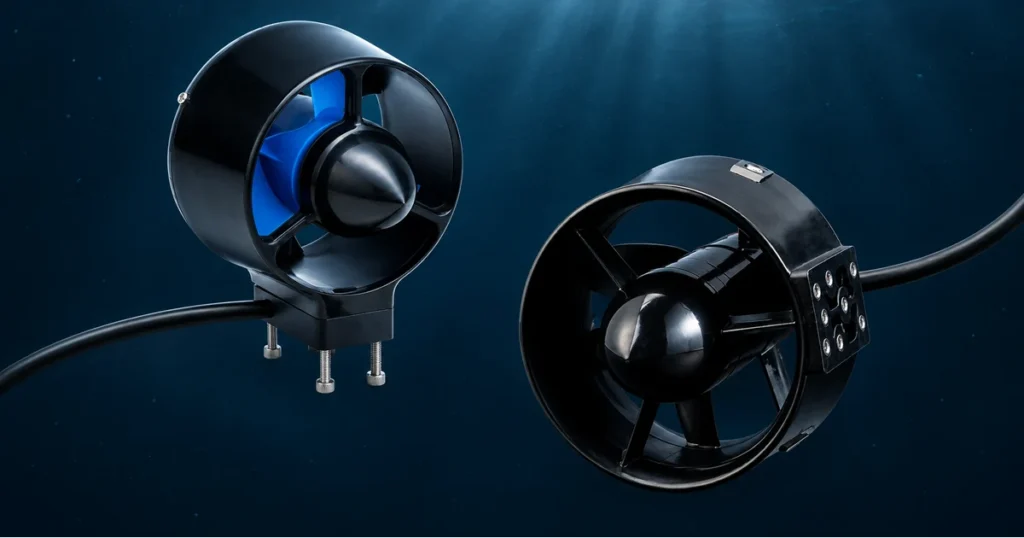
The AQUROV T2216 and New T200 (T2820) are two different brushless underwater thruster solutions. The T2216 is available in integrated-ESC and external-ESC configurations, while the current New T200/T2820 uses a polymer sliding-bearing design and a compatible external ESC.
This guide compares the models and answers practical questions about thrust, PWM control, watertight connections, independent thruster operation, and maintenance.
1. What Is the Difference Between T2216 and New T200 (T2820)?
The most important differences are the bearing arrangement, controller configuration, mechanical construction, and available performance data.
The T2216 uses a stainless-steel bearing arrangement and is offered in versions with and without an integrated electronic speed controller (ESC). The integrated configuration can simplify compact ROV installations, while the no-ESC model allows the system designer to choose a compatible external controller.
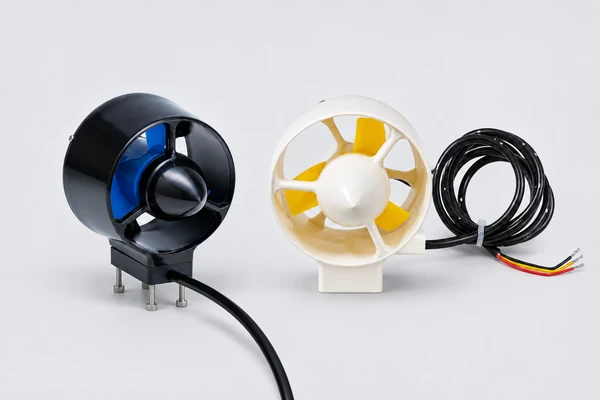
The New T200, also known as T2820, uses an open brushless motor with polymer sliding bearings and an ABS + PC housing.
It is offered with clockwise (CW) or counterclockwise (CCW) propeller configurations. The regular configuration is intended for unrestricted water flow, while the education version includes a protective grille that reduces thrust relative to the regular configuration.
Its standard cable length is 1 m.
| Feature | T2216 | New T200 (T2820) |
|---|---|---|
| Motor | Brushless underwater motor | Open-design brushless underwater motor |
| Bearing | Stainless-steel bearing arrangement | Polymer sliding bearings |
| ESC Configuration | Integrated-ESC or no-ESC version | External ESC required |
| Standard Cable | Depends on selected configuration | 1 m |
| Propeller Selection | Match the ordered configuration | CW / CCW options |
| Housing | Refer to dimensional drawing | ABS + PC |
| Performance Data | 12 V, 16 V, and 24 V test data | 12 V, 16 V, and 24 V performance curves |
Neither bearing type is universally better in every environment. Water-lubricated polymer bearings depend on appropriate operating conditions, and metallic bearings also require suitable corrosion protection and maintenance.
Engineering recommendation: Compare the complete thruster assembly, including electrical input, thrust output, mounting requirements, and maintenance conditions—not just one material or peak thrust figure.
2. How Much Thrust Does the T2216 Produce?
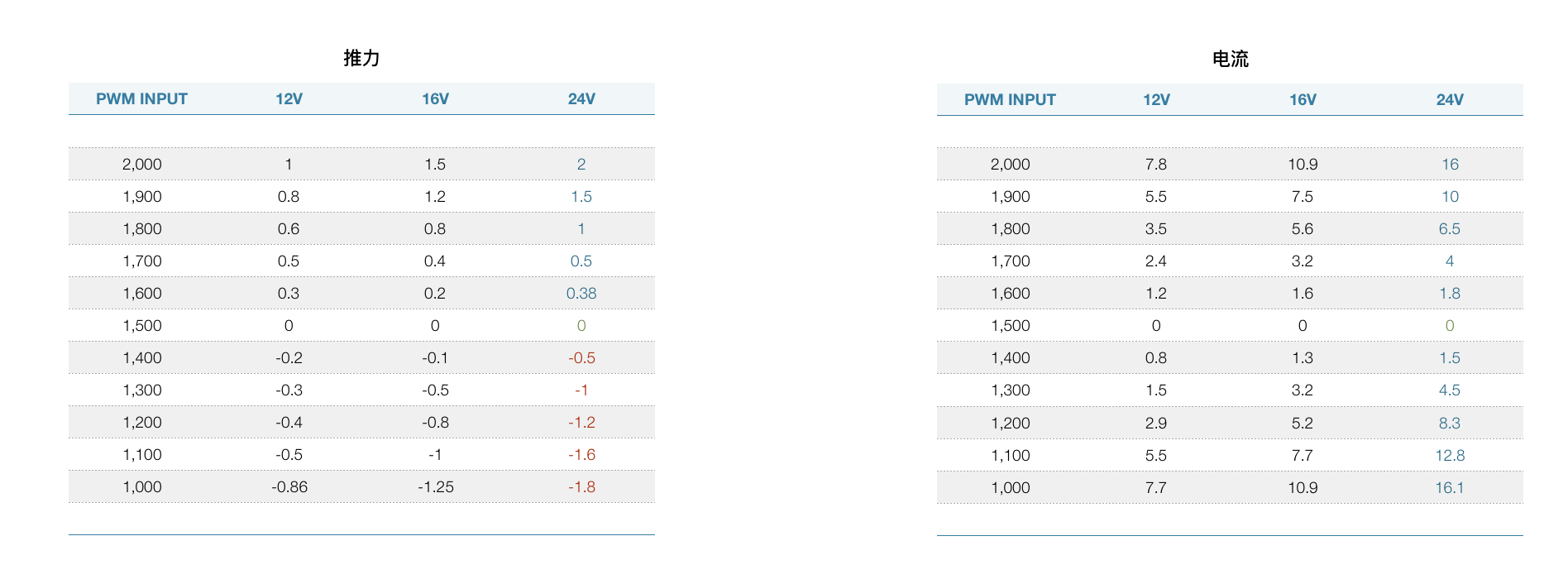
The T2216 performance data covers three supply voltages: 12 V, 16 V, and 24 V.
The measurements use PWM commands between 1000 and 2000 μs, with 1500 μs as the neutral position. Positive and negative thrust values indicate opposite thrust directions.
| Voltage | Forward Thrust (2000 μs) |
Current (2000 μs) |
Reverse Thrust (1000 μs) |
Current (1000 μs) |
|---|---|---|---|---|
| 12 V | 1.0 kgf | 7.8 A | 0.86 kgf | 7.7 A |
| 16 V | 1.5 kgf | 10.9 A | 1.25 kgf | 10.9 A |
| 24 V | 2.0 kgf | 16.0 A | 1.8 kgf | 16.1 A |
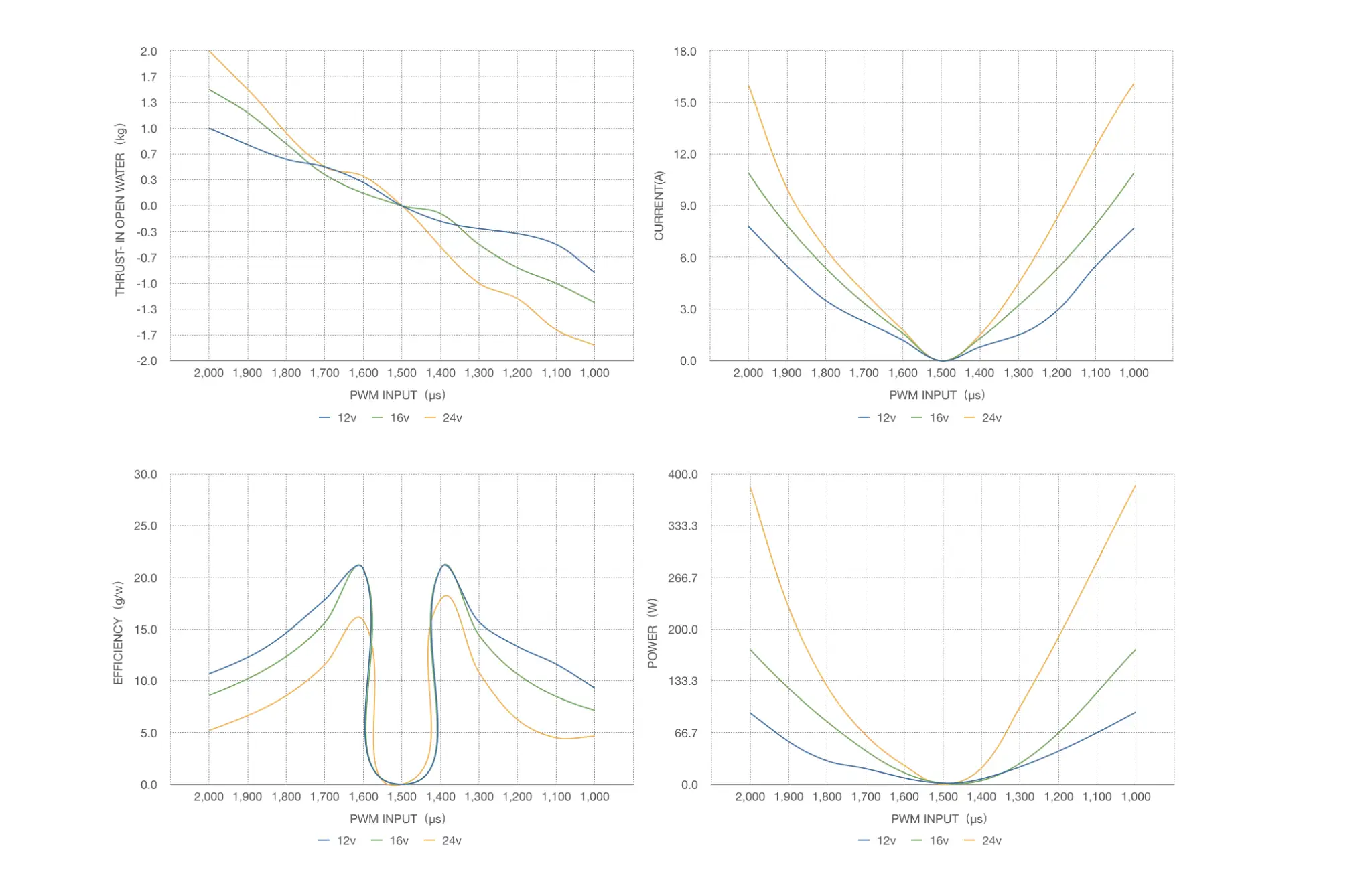
T2216 Thrust, Current, Efficiency, and Power Curves
Detailed performance curves illustrate how thrust, input current, electrical power, and the measured thrust-to-power ratio change with PWM commands.
For engineering selection, evaluate thrust together with current and electrical power, rather than selecting a thruster solely from its highest thrust value.
How Does New T200 (T2820) Compare?
The current New T200 (T2820) product page provides performance curves for 12 V, 16 V, and 24 V operation.
When comparing the two models, use equivalent supply voltages and documented test conditions. Performance measurements from different setups should not be treated as a direct head-to-head comparison.
For the latest T2820 specifications, see the New T200 Brushless ROV Thruster product page.
3. Does T2216 Include a Built-In ESC?
The T2216 is available in two electrical configurations.
T2216 With Integrated ESC
The integrated-ESC assembly includes the electronic speed controller as part of the thruster configuration. This can reduce the number of separate electronic modules and simplify integration into a compact ROV.
T2216 Without ESC
The no-ESC version requires a compatible external three-phase brushless motor controller. This configuration allows system integrators to select an ESC according to their power architecture and control requirements.
What ESC Does New T200 (T2820) Need?
The New T200/T2820 requires a compatible external ESC.
AQUROV recommends the 35 A version from its Thruster ESC 20A–45A family for the New T200.
For forward and reverse operation, select a compatible bidirectional ESC and verify the operating voltage, current capacity, wiring, and thermal requirements.
An ESC is not simply an on/off switch. It electronically commutates the brushless motor and regulates its speed and direction.
4. How Do DC Power, PWM Control, and Motor Wiring Work?
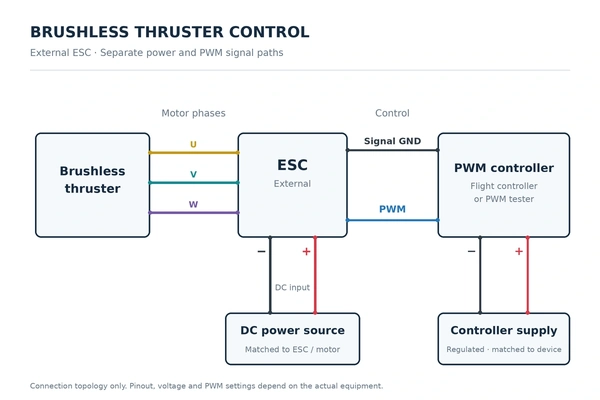
In a typical underwater brushless propulsion system with an external ESC, the electrical connections perform three separate functions.
- DC Power: The battery or regulated DC power source supplies electrical energy to the ESC.
- Control Signal: A flight controller, motor tester, or other compatible control device sends commands to the ESC.
- Three-Phase Motor Output: The ESC drives the brushless motor through three phase conductors, commonly identified as U, V, and W.
Understanding PWM Control
For an RC-style PWM control interface, pulse width represents the requested motor command.
In the supplied T2216 test configuration:
- 1500 μs: Neutral position.
- Above 1500 μs: Thrust in one direction.
- Below 1500 μs: Thrust in the opposite direction.
- Control frequency: 50 Hz in the documented test arrangement.
These values describe the tested controller configuration. The appropriate PWM limits, neutral setting, and direction behavior must match the selected ESC.
It is important to distinguish the PWM control signal from the motor’s power connections.
The ESC receives DC power and a compatible control command, then generates the controlled three-phase output required by the motor.
Before commissioning, verify supply polarity, signal ground, connector pinout, PWM range, and motor direction. Do not rely on cable colors alone when integrating components from different manufacturers.
5. How Should Thruster Cables Pass Through a Watertight ROV Enclosure?
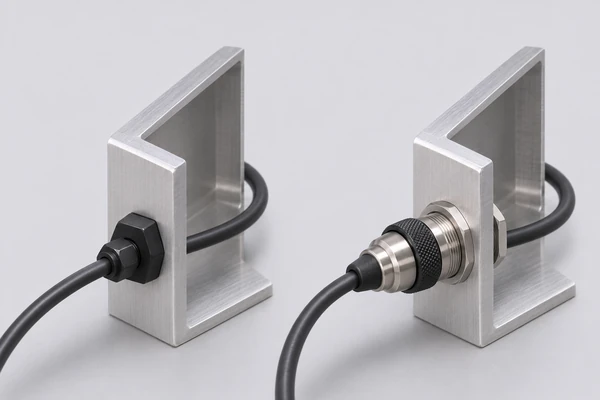
Two common connection methods are cable penetrators and underwater electrical connectors.
Option A: Cable Penetrators
A cable penetrator creates a sealed passage through the wall of an electronics enclosure.
Potting-based penetrators can provide a compact and economical connection for permanent cable installations.
Advantages:
- Compact installation.
- Relatively economical.
- Suitable for permanent cable routing.
- Fewer detachable interfaces.
Considerations:
- Cable replacement can require additional work.
- Seal performance depends on proper installation.
- The penetrator must match the cable diameter, enclosure hole, and operating pressure.
Option B: Underwater Electrical Connectors
Underwater connectors provide a detachable electrical interface between the thruster and the vehicle.
They can simplify assembly, troubleshooting, maintenance, and component replacement.
Advantages:
- Convenient modular installation.
- Easier component replacement.
- Useful for serviceable ROV designs.
Considerations:
- Generally higher component cost.
- Additional sealing interfaces.
- Electrical and pressure ratings must match the system requirements.
For a compact, permanent installation, a cable penetrator may be the practical choice. Where field replacement and modular maintenance are priorities, a properly rated underwater connector may be more appropriate.
6. Can Multiple ROV Thrusters Be Controlled Independently?
Yes. A suitable flight controller or motor-control system can send individual commands to separate ESC channels.
The ROV control software can coordinate multiple thrusters to achieve:
- Forward and reverse movement.
- Turning and yaw control.
- Vertical movement.
- Vehicle stabilization.
- Additional maneuvering functions supported by the thruster arrangement.
However, independent speed control and physical power disconnection are different functions.
A waterproof connector does not itself provide motor speed control or a safe emergency isolation method.
Normal starting, stopping, and direction changes should be handled through the ESC and control system. Electrical protection and power isolation should be designed separately.
7. Installation and Maintenance FAQs
Can T2216 or New T200 Run Outside Water?
Avoid prolonged dry running.
Underwater propulsion systems may depend on surrounding water for heat removal and, in certain bearing designs, lubrication.
This is particularly important for thrusters using polymer sliding bearings.
Follow the model-specific commissioning procedure for any short out-of-water functional test.
How Should I Select CW and CCW Propellers?
Select the propeller configuration together with its installation orientation and commanded motor rotation.
Proper propeller arrangement helps generate the intended thrust direction and can balance reaction torque in multi-thruster vehicles.
Verify rotation and thrust direction during commissioning at a safe test power level.
Is the Thruster Depth Rating the Same as the ROV Depth Rating?
No. The operating depth of a complete ROV is limited by the ratings of all submerged components.
These may include the thrusters, cables, connectors, penetrators, electronics enclosures, sensors, and other equipment.
A depth rating for one component does not establish the operating depth of the entire vehicle.
What Should Be Inspected After Operation?
Disconnect electrical power before inspecting or touching the propeller.
Routine checks should include:
- Removing debris or fishing line from the propeller area.
- Inspecting cable insulation and strain relief.
- Checking mounting hardware for looseness or corrosion.
- Inspecting connectors and seals according to their maintenance instructions.
- Following the recommended freshwater-rinsing and storage procedure after saltwater use.
8. Practical ROV Thruster Selection Checklist
Before selecting a thruster for a new underwater robotic system, define the following requirements.
- Required Thrust: Estimate vehicle drag, expected currents, maneuverability requirements, and desired thrust margin.
- Electrical System: Establish supply voltage, current capacity, peak and continuous loads, and ESC compatibility.
- Mechanical Integration: Verify mounting dimensions, frame geometry, propeller clearance, and cable routing.
- Operating Environment: Consider working depth, salinity, temperature, debris exposure, and operating duration.
- Control and Maintenance: Confirm controller channels, signal compatibility, watertight connections, and access for servicing.
Related AQUROV Products and Technical Resources
Explore the corresponding AQUROV products and engineering resources for detailed specifications, mechanical integration, and electrical system design.
T2216 Underwater Thruster
Integrated ESC Version
T2216 Underwater Thruster
Without ESC Version
New T200 (T2820)
Brushless Underwater Thruster
Thruster ESC 20A–45A
Brushless Motor Controller
Conclusion
The T2216 is a compact underwater thruster family available with integrated or external ESC configurations, while the current New T200 (T2820) uses a polymer-bearing design and operates with a suitable external ESC.
The right selection depends on verified electrical performance, mounting requirements, control integration, and operating conditions—not simply the largest thrust figure in a product listing.
By reviewing performance curves, electrical compatibility, enclosure connections, and maintenance requirements during the design stage, engineers can reduce integration difficulties and improve the reliability of underwater robotic propulsion systems.