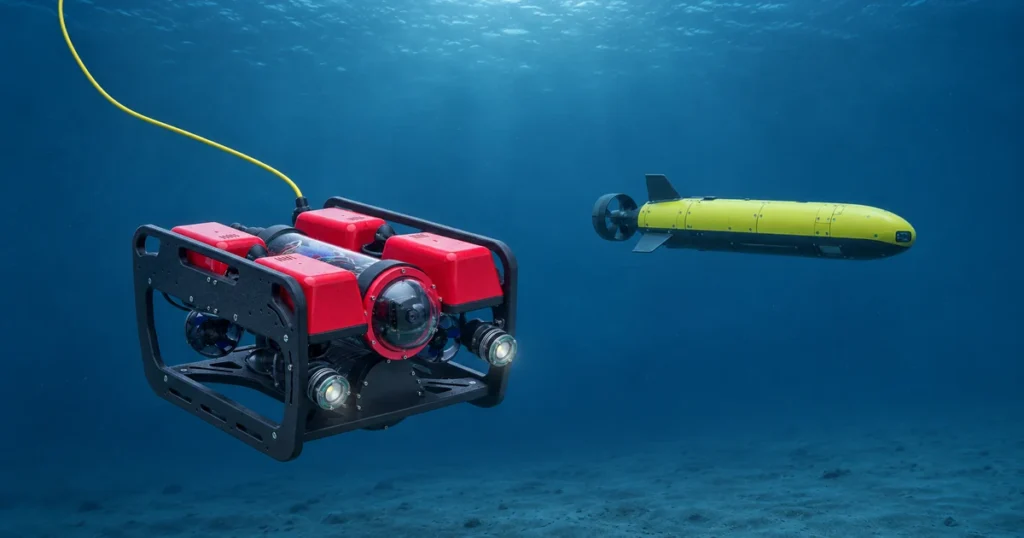
An ROV (remotely operated vehicle) is an underwater robot operated through a tether from a surface control station. An AUV (autonomous underwater vehicle) carries out underwater missions without a tether or continuous pilot input.
The main difference is how the vehicle is controlled and connected to its operator. ROVs are a practical choice for live inspection and intervention, while AUVs are well suited to planned surveys and autonomous data collection. The right platform depends on the task, operating environment, payload and deployment requirements.
What is an ROV?
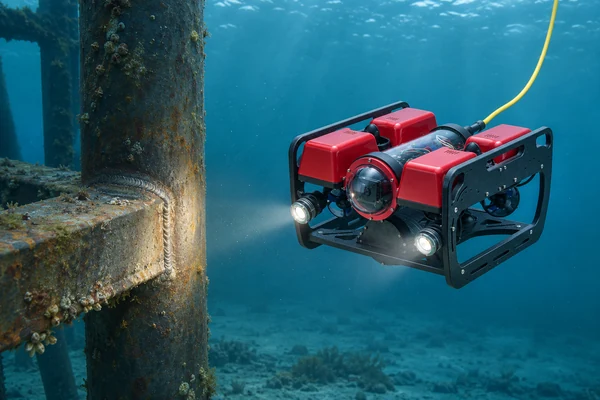
An ROV is an uncrewed underwater vehicle controlled from a boat, shore or another surface station. Its tether carries commands to the vehicle and returns data to the operator. On a camera-equipped system, that connection allows the pilot to watch live video and respond as the work develops.
ROVs can carry cameras, lights, sonar, environmental sensors and manipulators. Typical tasks include hull and structure inspection, targeted observation, sample collection, object recovery and tool operation.
Remote operation can also include automatic assistance. Systems based on ArduPilot Sub, for example, can provide depth control, position hold and automatic mission modes when the required sensors and configuration are available. These features help the operator manage the vehicle while concentrating on the task.
ROVs range from compact inspection vehicles to large platforms with substantial tooling and support equipment. Their size and cost are determined by the application.
What is an AUV?
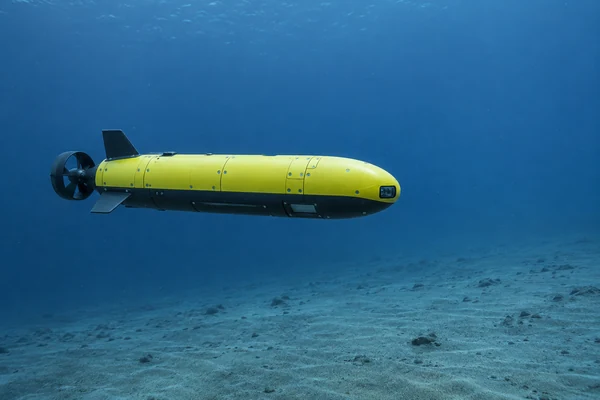
An AUV uses onboard navigation, control and energy systems to execute an underwater mission. Operators define the survey area, route, depth or altitude, sensor settings and recovery arrangements before deployment. The vehicle then carries out its task without continuous manual steering.
Common applications include seafloor mapping, environmental monitoring, repeated survey routes and other structured data-collection missions. Full datasets are commonly stored onboard and retrieved after the vehicle is recovered.
Some AUVs use acoustic communication to report status or receive mission updates while submerged. Surface communication can provide additional options when the vehicle returns to the surface. The available communication functions depend on the platform.
AUV designs include cruising, hovering and gliding vehicles. Their shape, propulsion and sensor arrangement are selected around the intended mission.
ROV vs AUV: comparison at a glance
| Feature | ROV | AUV |
|---|---|---|
| Main control method | Surface operator with live feedback; automatic assistance may be available | Onboard control executes a mission without continuous pilot input |
| Surface connection | Tethered during normal operation | Untethered during autonomous operation |
| Data access | Live video and sensor data can return through the tether | Full datasets are commonly stored onboard; underwater communication varies by system |
| Power arrangement | Onboard batteries or surface power, depending on the platform | Onboard energy for autonomous operation |
| Typical applications | Inspection, targeted observation, sampling and intervention | Planned surveys, mapping and environmental data collection |
| Deployment considerations | Tether routing, handling, access and launch equipment | Navigation, mission planning, energy reserves and recovery |
| Size and cost | Depend on payload, depth, performance and support equipment | Depend on payload, depth, performance and support equipment |
When should you choose an ROV?
An ROV is a useful starting point when the work requires live observation, immediate decisions or physical interaction with a target.
Close-range inspection
For hulls, moorings and subsea structures, an operator may need to slow down, change the camera angle, revisit a feature or investigate unexpected damage. Live feedback makes it possible to adapt the inspection during the dive.
Define the required image quality, lighting, viewing distance and vehicle movements before selecting the platform. A vehicle that reaches the target depth must also be able to approach and inspect the target effectively.
Sampling and intervention
A manipulator-equipped ROV can collect selected samples, retrieve objects or position tools. These tasks depend on the operator's view of the target, the vehicle's stability and the tool's working envelope.
Plan the complete operation: how the vehicle approaches, how the tool engages the object and how the vehicle returns with its payload.
Flexible inspection routes
ROVs are also useful when the route or task is likely to change. The operator can respond to new information throughout the dive, provided the vehicle and tether arrangement allow access to the work area.
When should you choose an AUV?
An AUV is a useful starting point when the main deliverable is a planned dataset collected over a defined area or route.
Survey and mapping missions
An AUV can follow planned survey lines while collecting sonar, photographic or environmental data. The payload, navigation system and mission plan must support the required coverage and data quality.
Specify the survey area, required resolution, sensor operating conditions and positioning requirements before comparing vehicles.
Repeated observations
For environmental research and monitoring, an AUV can revisit planned routes or observation locations. Repeatability depends on navigation performance, sensor configuration and consistent mission settings.
Combined ROV and AUV operations
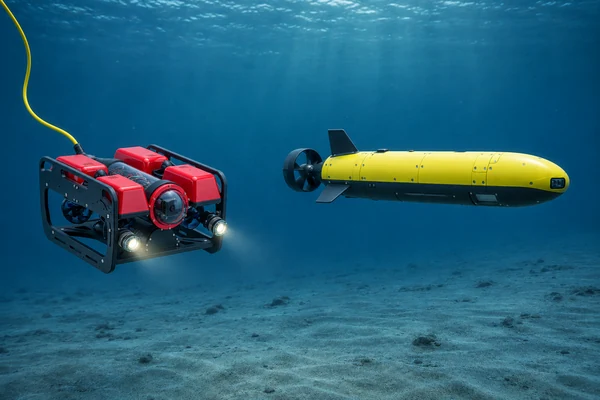
The two vehicle types can complement each other. An AUV survey can identify an area of interest, followed by an ROV for live inspection or sampling. For projects with both coverage and intervention requirements, this approach can be more practical than asking one platform to perform every task.
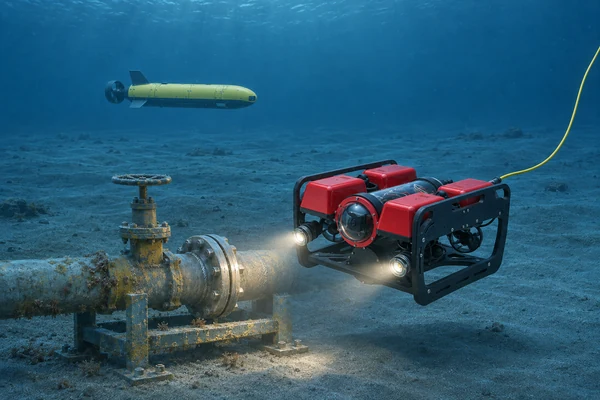
Which is more accurate: an ROV or an AUV?
Neither vehicle type is automatically more accurate. Accuracy must be considered in relation to the job:
- Navigation accuracy: how well the system knows the vehicle's position and follows the intended route.
- Measurement performance: whether the camera, sonar or other instrument produces the required data.
- Control performance: how well the vehicle maintains the position and orientation needed for inspection or tool use.
An ROV can perform detailed inspection and precise intervention. An AUV can collect structured survey data along a planned route. In both cases, the result depends on the sensors, navigation, calibration, control system and operating conditions.
Conventional satellite GPS is not directly available to a submerged receiver through seawater. Underwater positioning may combine acoustic systems, inertial navigation, Doppler velocity measurements or other suitable methods. The correct arrangement depends on the required accuracy, operating area and platform.
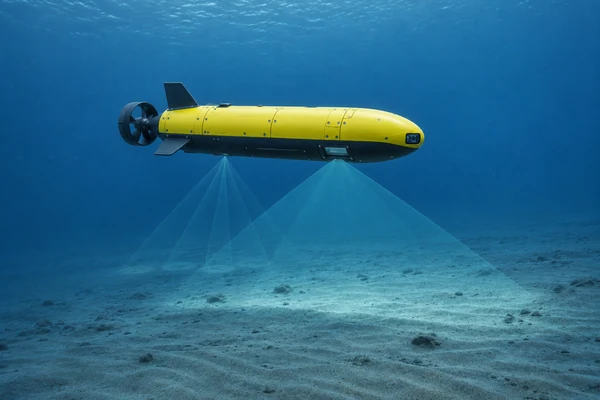
How vehicle choice affects component selection
ROVs and AUVs share many component categories, including propulsion, enclosures, connectors, sensors and buoyancy materials. Select each component around the vehicle's electrical, mechanical and mission requirements.
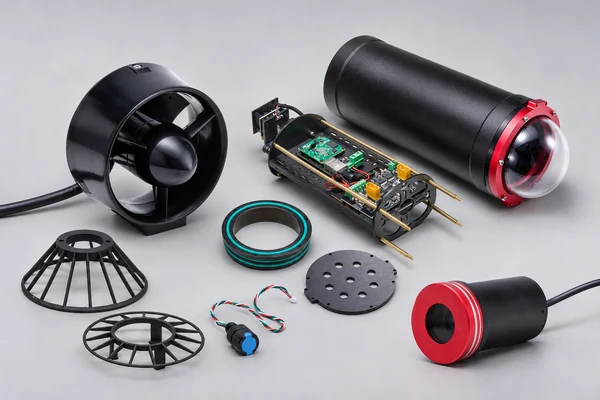
Thrusters and motor controllers
Review thrust, current and power at the intended supply voltage. Consider the required vehicle movements, mounting geometry, flow clearance and controller capacity.
The AQUROV New T200 Brushless ROV Thruster, also known as the T2820, uses 316 stainless steel bearings and delivers a maximum thrust of 7.5 kgf at 24 V. When integrating it into a vehicle, use the performance curve for the planned operating voltage and select a compatible ESC.
Maximum thrust is one operating point. The vehicle's normal power demand and available thrust throughout the mission are also important when planning its propulsion system.
Tether communication
For a tethered build, match the vehicle-side and topside interfaces to the cable and payload data requirements. Review connector arrangements, cable length, power supply and the communication modules at both ends.
The AQUROV Tether Interface Board provides a wired communication option for ROV integration. Assess the complete link under the intended cable and installation conditions when planning live video, telemetry and control.
Enclosures and cable connections
Enclosure material and assembly configuration affect operating depth. AQUROV's aluminum enclosure option supports operation to 300 m, while the acrylic option is intended for shallow-water applications at depths of a few tens of metres. Confirm the depth rating of the selected assembly when choosing the tube, end caps, seals and cable entries.
The Underwater Electronic Enclosure page provides the available kit options. Use the CAD file for the selected material and version when planning internal space and mounting.
Buoyancy and trim
Choose buoyancy material for the target depth, required uplift and available space. Include covers, brackets, payloads and other hardware when planning the vehicle's buoyancy and trim.
The 300 m ROV Buoyancy Foam is suitable for applications within its 300 m applicable water depth. Check the assembled vehicle's balance in water after fitting the equipment.
Tools and sensing payloads
For intervention tasks, review the tool's functions, mounting envelope, power requirements and control interface. The 2-DOF Underwater Robotic Gripper provides jaw opening and closing together with gripper rotation for object handling and tool orientation.
For altitude or distance sensing, distinguish the instrument's measurement range from its operating depth. The Ping Sonar Altimeter & Echosounder is a single-beam device with a maximum measurement range of 50 m and a depth rating of 300 m. Select its mounting direction and operating settings around the distance measurement the vehicle needs.
A practical ROV and AUV selection checklist
Before comparing platforms or ordering components, define these six points:
- Mission deliverable: live inspection, a survey dataset, samples or a physical intervention.
- Operating environment: target depth, currents, visibility, access and obstacles.
- Control requirements: continuous operator decisions, automatic assistance or autonomous mission execution.
- Payload and data: instruments, electrical interfaces, storage and information needed during the dive.
- Deployment and recovery: launch equipment, tether handling where applicable, recovery arrangements and support personnel.
- Acceptance criteria: the performance, integration checks and operating conditions the completed system must meet.
Compare quotations against the same mission requirements. Include the sensors, control station, communication equipment, power system and deployment equipment needed to carry out the work.
Frequently asked questions
Can an ROV have autonomous functions?
Yes. An ROV can combine remote operation with depth control, position hold or automatic mission functions. The available modes depend on its sensors, software and configuration.
Can an AUV communicate while underwater?
Some AUVs can exchange status information and mission updates through acoustic communication. The bandwidth, range and available commands vary by system. A live video connection should be specified separately when evaluating a platform.
Are ROVs always cheaper than AUVs?
No. Both categories include systems with different sizes, depths, payloads and support requirements. Compare the total cost of meeting the same task, including sensors, navigation, deployment equipment and operation.
Which type can operate deeper?
The ROV or AUV designation does not establish a depth rating. Operating depth is determined by the exact platform, its components and the conditions under which the assembled system is rated.
Can the same thruster be used on an ROV and an AUV?
Yes, where its operating characteristics suit both designs. Check the required thrust and power, controller compatibility, supply voltage, mounting and operating depth for each application.
Technical resources for your build
Use AQUROV Technical Resources to access CAD files, drawings and manuals for the components in your project:
- New T200 / T2820 Thruster CAD
- Power-Line Communication Module CAD
- 110 Aluminum Electronics Enclosure CAD
- Ping Single-Beam Sonar User Manual
Browse the AQUROV component catalogue for standard parts. For help selecting components, send your mission, operating depth, supply voltage, payload and mounting constraints to AQUROV engineering support.